Where Queer People Actually Meet Now
There is a specific kind of article this is not: a list of the nine best gay bars in a city you do not live in. Those are easy to write and mostly useless, because the question underneath is not where is the nearest bar but where do I have a reasonable chance of meeting someone, given where I actually live.
So this sorts the options by what each one is genuinely good at.
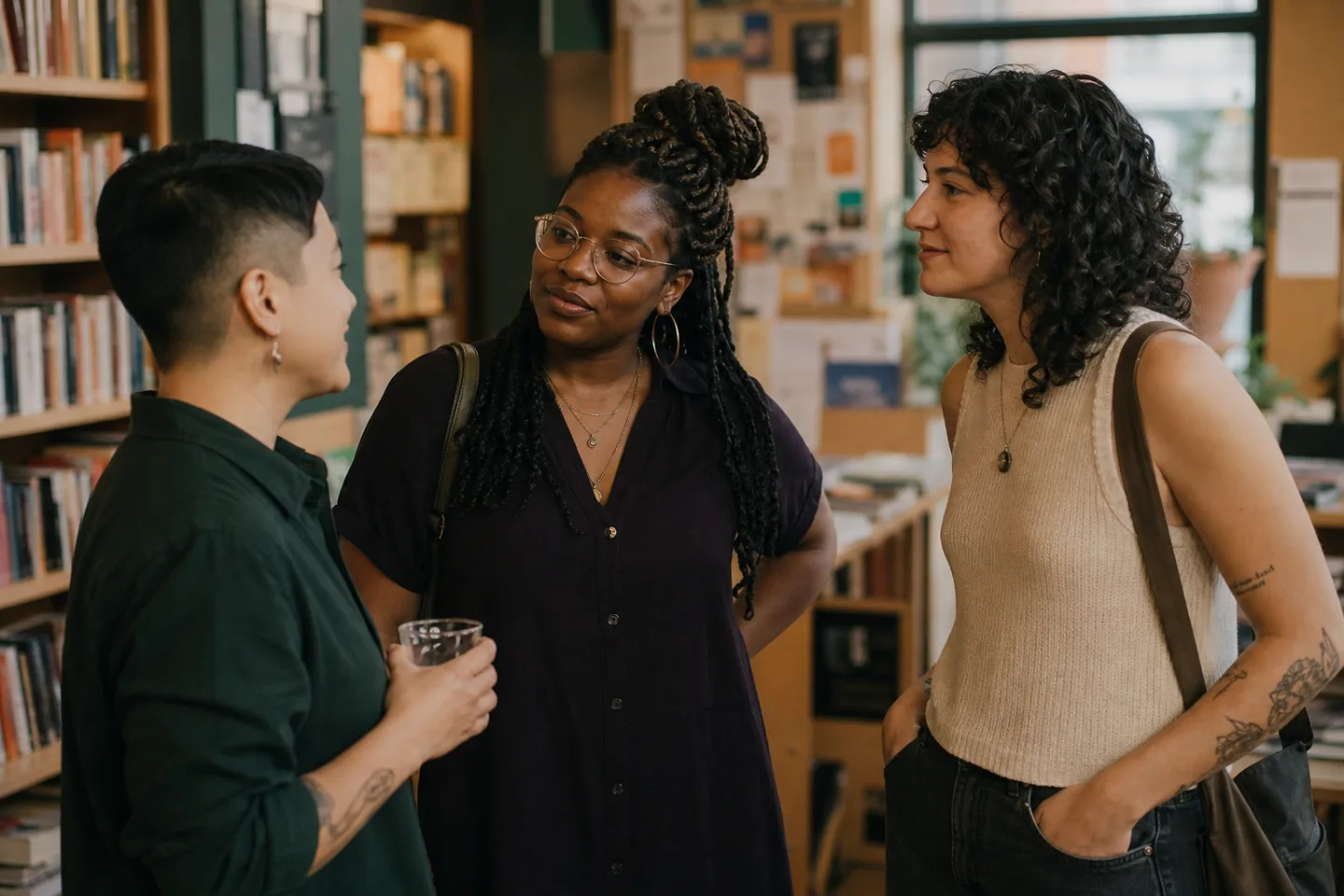
Places with a repeatable activity give queer women both a reason to talk now and a plausible reason to meet again.
The three routes, and what each is for
Apps are good at volume and speed, and bad at everything after that. They put you in front of more queer people in an hour than the rest of your month will, and they give you almost no basis for judging any of them. That trade is worth making when you are new to a city and worth reconsidering when you are tired.
Recurring groups — a league, a choir, a climbing gym, a monthly volunteer shift — are the opposite. Slow, small, and much better at producing anything lasting. The mechanism is unglamorous: you see the same people more than once, without either of you having announced an intention. Almost everything about meeting people gets easier when the meeting is not the point.
Scheduled events sit between the two. A monthly queer night, a film screening, a market stall. Enough new faces to be worth showing up for, enough regularity that the faces start repeating.

Bars: still real, much thinner than they were
The decline is documented and it is not evenly spread.
Lesbian bars took the worst of it. The Lesbian Bar Project, the best-known effort to document them, profiles 36 bars across the entire United States. Whatever the precise national total is, a number in that range means the same thing in practice: for a large share of the country, there is no lesbian bar within reasonable travel.
We have deliberately left out the much smaller nationwide count that circulates in news coverage. We could not confirm it against the project's own site, and a figure that specific should not be passed along on the strength of how often it gets quoted.
General queer bars held up better, especially in large metros, and worse in small cities where one closure removes the only option.
What that means practically: treat a bar as a thing you travel to occasionally, not as your local infrastructure. If your plan for meeting people depends on a venue existing within fifteen minutes of you, that plan will fail in most of the country.
If you are not in a major city
This is the case most nightlife guides quietly assume away.
Widen the radius before you widen the definition. A monthly night ninety minutes away that you actually attend beats a weekly one four hours away that you do not. Pick the largest city you can reach and back, and treat it as a scheduled thing rather than a spontaneous one.
Interest-first beats identity-first. A regional climbing group with some queer people in it will usually outperform a queer social group with nothing to do in it — because the first one has a subject and the second one has only the introductions. This holds online too.
Accept that the pool includes people you would not pick in a city. Not as a compromise, exactly. Smaller pools force you past the filtering that larger ones let you do endlessly, and people are frequently surprised by that.
What we are not going to tell you
We do not know how safe any of this is where you live, and we are not going to guess. Whether it is reasonable to be visibly out at a venue, on an app, or walking home from either, depends on a local reality we cannot see from here. Local organisations know that, and we do not.
We also have not vetted any specific venue, group, or app. Anything we name is a starting point for you to check, not a recommendation we are standing behind.